XII APZB Conference
A NEW LOOK FOR A MILITARY ORGANIZATION
RUSSIAN FEDERATION
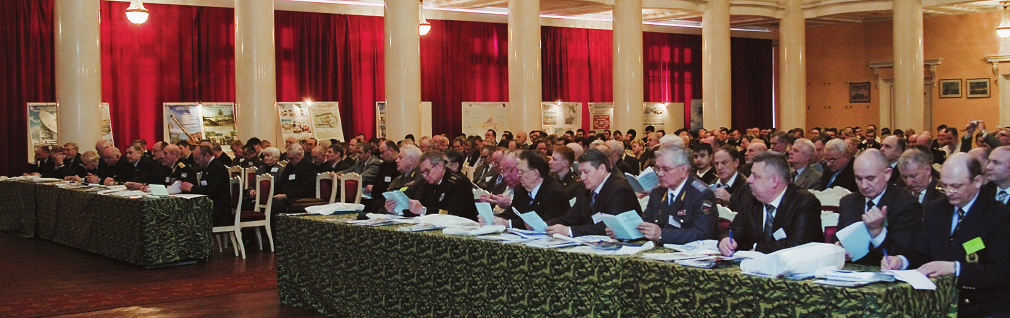
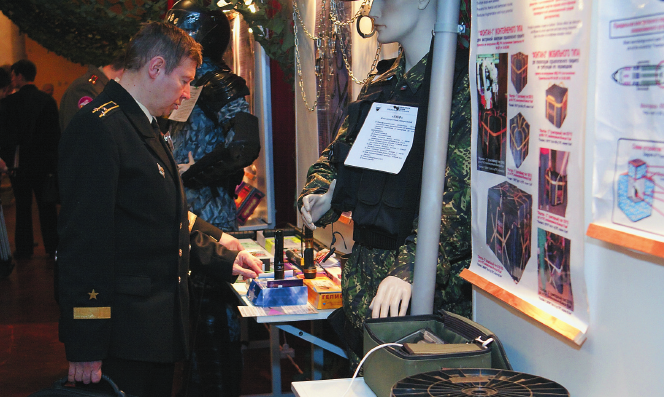
At the Naval Academy named after. Admiral of the USSR Fleet N.G. Kuznetsova hosted the XII All-Russian Scientific and Practical Conference “Current Problems of Defense and Security”, which brought together over seven hundred scientists, designers and specialists from enterprises and research institutions of the military-industrial complex, as well as generals, admirals and senior officers of the Armed Forces, the Ministry of Internal Affairs, the Ministry of Emergency Situations and other power ministries (departments)
Russian Federation.
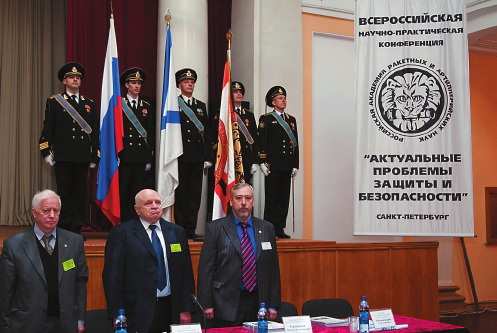
The conference opened - for the first time in its entire history - with a solemn ceremony of introducing the State Flag of Russia, the banners of the Naval Academy and the Russian Academy of Missile and Artillery Sciences. Next, the National Anthem of the Russian Federation was performed. But unlike previous ones, the first plenary session of the current conference opened without the previously accepted numerous congratulations and wishes addressed to the participants and guests.
Let us note that the first conferences took place in the context of a deepening crisis in the defense industry. In the 90s, military science and the defense industry essentially had one and only problem - to preserve, to the extent possible, the potential of the defense industry, primarily intellectual resources. In other words, survive. Many, including the top leaders of the Russian state, were then convinced (or pretended to be convinced) that after the end of the Cold War, the threat of a large-scale attack on Russia by former potential adversaries was forever a thing of the past. Such misconceptions had objective reasons. After all, the geopolitical situation that emerged after the collapse of the USSR, combined with Russia’s remaining powerful potential of strategic nuclear deterrent forces, as well as the absence of contradictions that could not be resolved without the use of military intervention, provided our country with a “security window”for a period from 10 to 20 years.
The reliability of such a “window” was also confirmed by the fact that at that time the armies of the NATO bloc had just begun to launch long-term rearmament and technical re-equipment programs, as well as the development of fundamentally new methods of conducting combat operations. However, the first results of this work are now visible, and there is no doubt that the rearmament of NATO armies will be gradually completed between 2015 and 2020.
It can be assumed that the deployment of new systems of offensive and defensive weapons, as well as the accession of more and more European countries to the NATO bloc, is just a small part of the plans aimed at gaining US military and geopolitical dominance in the so-called unipolar world.
At the same time, one cannot underestimate the potential threat to Russian interests from the direction opposite to the West, where China is doing everything possible to build up its defense and offensive capabilities. It is expected that in the field of production and development of weapons of mass destruction, delivery vehicles, as well as in the creation of related military technologies, the Chinese will overcome the gap with Russia in the early 20s.
Thus, we should expect that the “security window” for Russia will slam shut in the very near future, and at the turn of 2015–2017 large-scale military threats may arise, primarily caused by the intensifying struggle for the possession of energy, biological and water resources. Even the Arctic could become a new theater of war.
Currently, Russia has confidently declared itself as the leading subject of the world energy system, the most important source of energy resources, and for Western Europe - the main guarantor of reliable energy supply. The current situation requires a revision not only of our country’s role in the system of existing world economic relations, but also the development of new approaches to its geopolitics, including issues of ensuring economic and military security. The latter is associated with the development of all components of the military organization of the state, since forceful confrontation in modern conditions includes methods of both military and non-military struggle with the enemy.
In recent years, the public has received more and more unambiguous signals that the top leadership of our country is aware of the ongoing geopolitical changes and is doing a lot to respond adequately in order to ensure the sovereignty and security of Russia. Building up military power is a necessary condition for this.
Most of the reports presented at the conference directly or indirectly took into account fundamental changes in the geopolitical space and Russia’s place in it. The need to dramatically increase the efficiency of the defense industry complex and strengthen the country's defense capability was the leitmotif of the main reports delivered at the plenary sessions of the conference.
So what is the new look of the army and navy? Those present at the conference learned about this from the report of the deputy head of the research department (problems of military development of the Russian Federation) of the Center for Military-Strategic Research of the General Staff of the Russian Armed Forces, Doctor of Technical Sciences, Colonel Sergei Belokon.
“Large-scale rearmament of the Armed Forces has been talked about for a long time,” the speaker recalled.
– If in 2013 it is planned to equip up to 30% of the troops with new types of weapons and military equipment, then by 2020 this figure should rise to 70%. Whether the financial and economic crisis will make adjustments to these propositions will depend on the state and development of the Russian military-industrial complex (DIC). In the early 90s, it already had to fall rapidly, factories stood still, were repurposed, and closed. And what can we say if in 10 years the volume of state defense orders has decreased by almost 100 times. This continued until 2001, when, intending to recreate the real picture of what was happening, the authorities were forced to come to a disappointing conclusion.
The degradation of industry management that occurred as a result of thoughtless privatization, the reduction of production capacity, and the loss of technology led to the impossibility of placing mobilization tasks on a domestic basis. If war happens, there will be nothing to fight with.
But by this time, there was no way back to the previous administrative methods of management: after the transition to market relations, the state could only stimulate military technologies through an increase in defense orders. But even in the last 5 years, production capacity utilization at defense industry enterprises remains low, there is a shortage of specialists, especially qualified workers.
What is the defense industry today? These are 1,400 organizations and enterprises of various forms of ownership (state enterprises, joint-stock companies with and without state participation, members of state corporations), as well as more than 600 research institutes, scientific and production associations, design bureaus, and laboratories. The military-industrial complex, as the executor of the state defense order, which is increasingly focused on high-tech industries, now builds its relationship with the customer on the demonstration principle: the enterprise independently prepares samples and puts them up for competition, then the state compensates for the production of experimental samples. Of course, the defense industry system, which is just getting back on its feet, will not easily survive the crisis. But the country’s leadership, consistently pursuing an anti-crisis course and increasing allocations for the development of high-tech industries, intends to do everything to minimize the consequencescrisis for the country's defense capability.
The head of the 46th Central Research Institute of the Ministry of Defense of the Russian Federation, Vasily Burenok, recalled how time is pressing for us in matters of rearmament of the army and navy.
By 2020, NATO armies will adopt anti-satellite warfare information systems, making it possible to effectively confront the enemy in all environments, with an emphasis on space forces. A new information and combat space is being created, allowing targeted missile, information and other attacks on particularly important government, defense and economic targets of the enemy. The new generation of non-nuclear war will be equal in effectiveness to nuclear war. In addition to the already known ones, its arsenal will include hypersonic aircraft; space weapons, including satellite and ground systems, as well as systems for command and control of troops and weapons; advanced information tools that allow you to act in real time. Such forces open up unprecedented opportunities for NATO: at the same time it will be able to control up to 80% of the territory of the Russian Federation andup to 60% of defense industry facilities; Possessing high mobility, a potential enemy will be able to launch an air strike from a space outside the territory of the attacked country.
Consequently, we must first of all develop those weapons that are capable of inflicting the most sensitive blows on the aggressor’s troops, suppressing its military space and naval missile carriers. So far, allocations for the development of the country's defense capability are distributed as follows: for space and strategic missile forces - 20%, for ground forces - over 40%, for the Navy - about 15%, for the Air Force - 20%.
Which modern types of weapons are already available? In December 2006, the Topol M rocket was successfully launched, and the Bulava sea-based complex was next in line. New generations of submarine cruisers, aircraft, infantry fighting vehicles, missile attack warning systems, and much more are being created.
In the new state weapons program, which was built on the same principles as the previous one, priority is given to information-automated terrain reconnaissance systems and guidance systems associated with general command and control systems; jamming systems for enemy reconnaissance. In the field of space weapons, priority attention will be paid to the development of missile attack warning systems, the creation of space navigation devices and space control systems. Currently they are at the experimental stage.
In the development of the air force, hypersonic technologies, the proliferation of unmanned systems, and the development of aerospace defense are considered the most promising. As for the Navy, a course has already been set for the production of multi-purpose nuclear submarines and modern surface ships.
Many promising models are being created for the ground forces across the entire range of weapons and military equipment, but not enough attention is paid to the issues of their unification. Some self-propelled vehicles now
There are 5 types, but one should be. We have 8 modifications of tanks, they need to be transferred to one platform. Much needs to be done to improve the combat characteristics of high-precision weapons: means of striking important targets, supersonic missiles, etc. All this is impossible without qualitative improvements in domestic weather surveillance equipment, space detection systems, and increased reconnaissance efficiency.
On this path, in addition to financial, economic, organizational, and technological difficulties, problems arise that arise from the backwardness of the country’s national economic complex. For example, we have not conducted any exploration of natural resources for decades. As a result, the defense industry is experiencing a shortage of raw materials: 36 types of materials for creating air defense systems are not produced or mined in Russia, although there are certainly deposits of them in the country. There is no less of a problem with electronics, although the issue should have been put on a comprehensive basis long ago: not only does the country have a generally low level of electronic component base, no one keeps records of these products. It is not surprising that the level of information support in the troops leaves much to be desired.
“We have good plans, it’s clear where to go,” V. Burenok summed up his speech. “Now it’s a matter of completing them in an extremely short time frame.”
The conference participants waited with interest for the speech of the representative of the Public Chamber of the Russian Federation, Vladimir Bogatyrev. He devoted his speech to the problem of individual protection and combat equipment for fighters, the fundamental approaches to the creation of which, according to him, are not prescribed in any regulatory document. Hence the practice of financing the creation and purchase of combat equipment goes anyhow. And without a systematic approach, it is difficult for the customer to understand the too large range of products offered by different manufacturers. At the Commission of the Public Chamber, specially assembled after the events in Tskhinvali, working under the leadership of S.B. Ivanov, came to the conclusion that the level of equipment of soldiers and officers was lower than that of the Georgians with their NATO equipment. As a result, for the first time in the main document of the Public Chamber of the Russian Federation, issues of combat equipment for military personnel were raised in the context of the national programsecurity.
The speaker recalled that the adoption of the national security strategy has been completed and the adoption of a new Military Doctrine is expected in September. He expressed the wish that these documents would not suffer the fate of the latest military reform, according to which not a single real result had been achieved in the first quarter of 2009. This largely stems from the state’s insufficient attention to the problems of the defense industry, which has always been the locomotive of the development of industry and science. Currently, 1,400 defense industry enterprises employ one and a half million people. They account for 2.6–2.7% of GDP, 70% of all high-tech products produced in Russia, and about 50% of the country's scientific workers. In connection with the global financial crisis, it is especially important that the defense industry does not slide to the level at which it was in the early 90s. It is necessary to maintain and develop the stable dynamics in the development of all areas of the defense industry, which has been achievedachieved in recent years. There are many reasons for concern: budget non-payments to defense industry enterprises have begun again; Wages remain low, resulting in the average age of defense industry workers being 50 years. In terms of labor productivity, we lag behind foreign manufacturers by more than 5 times. Gaps in the regulatory framework are making themselves felt - we need laws on the Armed Forces, on state defense procurement, on civilian control, but they are all missing. Therefore, it is difficult to block postscripts and gray schemes, the vicious practice of holding competitions in which preference is given not to manufacturers, but to intermediaries who inflate prices by 1.5–2 times, and other negative phenomena.
The representative of the city government, General Lieutenant V.S., dedicated his speech to the security problems of such a metropolis as St. Petersburg. Sukhoruchenko. In St. Petersburg, he emphasized, 84 million rubles are spent on security purposes. per year. Moreover, safety is understood broadly: from the protection of potentially dangerous objects, of which there are about 180 in the city, to road safety (over the past 5 years, with a steady increase in the number of vehicles, the number of road accidents has decreased by 49%, and the number of fatalities in them has decreased by 2.5 times).
This topic was picked up by Academician of the Russian Academy of Sciences Alexander Matveenko in a short unplanned speech dedicated to the protection of aircraft and vehicles from explosions. He showed stunning footage of a tank filled with gasoline being set on fire through the top hatch, with only a faint flame escaping. Gasoline cans and gas cylinders are hot welded, but there is no explosion. It turns out that if, after blocking, you reduce the volume of a canister or gas tank (for example, by filling them with foil or hollow metal balls), they will not explode in any accident! Two factors work to achieve the effect: small volume and equalization of temperature fields.
The speech of Lieutenant General Alexander Kovalev from the State Unitary Enterprise Design Bureau "Arsenal" was devoted to the problems of space exploration. New spacecraft are constantly being launched around the world, he emphasized; now there are already more than 400 of them in orbit. In order for them to successfully cope with their tasks: weather observation, communications, reconnaissance, navigation, etc., they need an energy source, protection systems against space debris, and much more. To solve these problems, Arsenal Design Bureau has been working for many years on the creation of space platforms with nuclear power plants, one of which is called “Plasma 20-10”. A promising space platform must be universal: it can accommodate space complexes for various purposes - military and dual-use vehicles. Such space-based assets are equipped with various protection systems: electronic warfare,laser and others, the need for which is increasing. The speaker recalled that in February 2008, the Americans demonstrated their capabilities by destroying their own space satellite launched from the Pacific Ocean by a ship-borne missile. And recently the Japanese threatened to do the same with the Korean satellite if it was launched. We carried out a similar launch 40 years ago, but then work in this direction was abandoned.
The general director of the capital's financial corporation, Pavel Gennel, brought the audience back to the topic of Russia and its defense industry emerging from the financial crisis. He explained why, although there is money in Russia and banks receive it from the government, it does not go into the real sector of the economy. In the current unstable environment, banks refrain from direct lending because they cannot assess the risks. Therefore, it is necessary to look for other, non-credit, methods of financing. They could be bonded loans that have proven themselves well in recent years. In addition to reliability, they have another advantage - the possibility of reusable use.
First Vice-President of the Academy of Geopolitical Problems, Konstantin Sivkov, presented a large-scale analysis of the geopolitical situation of Russia and its prospects for the near future.
He called the global financial crisis just the tip of the iceberg of global processes, which are based on insoluble political, financial and economic contradictions. The speaker included the imbalance between the volumes of production, consumption and the ecological capabilities of the planet, between industrialized and backward countries, between the high population of some territories and the low population of others. The processes of globalization of the world economy have already led to a glaring imbalance between the volume of the “dollar bubble” and the volume of real production. The collapse of transnational corporations can be caused by the lack of their political subjectivity. In short, a crisis of world order is coming. And now war is inevitable. The United States, of course, will try to maintain its unconditional superiority and will not want to put up with the emergence of new world centers. But there will be several stages before it is unleashed.
Initially (from 2 to 5 years), unions of states will be formed and their goals and objectives will be determined. The United States is already trying, by nullifying the significance of the UN, to transform NATO into the League of Democratic States with the inclusion of Japan and Australia. However, without establishing military-political control over oil and other energy resources in the world, they will not achieve their goals and will not even survive. Hence the excitement about the creation of a missile defense system and attempts to achieve the curtailment of Russian nuclear potential. It is not surprising that one of Obama’s first initiatives was a proposal to reduce the nuclear potential of Russia and the United States by 5 times, which will reduce Russia’s defense capability several times.
At the second stage, the weakening of the state foundations of Russia will begin through local wars and internal armed conflicts, which will require us to create groups of 100 thousand to 500 thousand people.
Conflicts are most likely to arise in the following areas: the North Caucasus (Chechnya, Dagestan), Ossetia, Abkhazia, Crimea, the Barents Sea region, as well as Central Asia (Uzbekistan, Tajikistan). As a result of the consequences of reforming the Armed Forces, Russia will not be able to create 100,000-strong groups in more than two directions. This means that we will have to make concessions in the military-political and economic spheres.
It is urgent to increase the forces and assets of our armed forces, increasing the volume of the state defense order by 3–5 times. It is impossible to resolve the issues of financing defense activities with palliative measures. We must realize that only by nationalizing the raw materials industries will we have a chance to protect the country. The report of Viktor Stepanov from OJSC VNIITransmash was devoted to the problems of improving the fleet of armored vehicles and weapons. He emphasized that the troops are mainly armed with vehicles manufactured in the 70s and early 80s. 96% of the country's tank fleet has a service life of more than 20 years, 90% of which have not undergone major repairs. According to the state defense order, purchases of new tanks (T-90, T-90A, T-9-U) began in 2004 and were carried out in small batches. Now their share in the tank fleet does not exceed 4%. Our lag in this area was demonstrated by the South Ossetian conflict. In Georgiathere were T-72 tanks, modernized by Ukraine and Poland using the latest communications, navigation, and thermal imaging devices; We have older cars.
And in NATO, not only are new tanks being created (M1 A2, Leopard 2 A5, Challenger), but since 2000 there has been a continuous multi-stage process of modernizing old vehicles, in which the Americans bring their performance to the level of M1 A2. In terms of new technology, both foreign and domestic tanks have their advantages. NATO has superiority in such indicators as a more advanced, all-weather fire control system, projectiles of increased power, fuel compartment security, and advanced automated control systems for units. The newest Russian tanks are distinguished by their lower weight and dimensions, higher rate of fire, and better price-quality ratio. We were pioneers in many directions, but what one came up with was immediately adopted by others. For example, after our Shtora complex appeared at an exhibition in Abu Dhabi, it immediately began to be copied abroad.
And the forecasts are disappointing. As a result of budget sequestration, many R&D projects for 2009–2011 are being phased out or significantly reduced. Funding for work on all combat properties of tanks has been reduced by 2–2.5 times. Meanwhile, it is still too early to write off tanks from the combat arena. The Germans, for example, believe that they will retain their role in ground operations.
The head of the Mikhailovsk Military Artillery Academy, Lieutenant General Vladimir Konstantinov, expressed bewilderment in connection with the ongoing military reform. According to the data available to him, the total combat strength of the army's artillery will be reduced by 2 times. Motorized rifle brigades will be completely deprived of their artillery. In a real conflict this will not lead to anything good.
Alexander Averchenko, advisor to the general director of the Federal State Unitary Enterprise Central Research Institute of Chemistry and Mechanics, complained about the crisis and confusion in the defense complex, where management schemes are constantly changing. But the problems that have existed and remain without solution - take one such as a possible shell famine at the beginning of the war. There is an elementary shortage in the country: there are no materials for shell casings and their lining, the production of cellulose and the processing of flax for them has been completely neglected, and the technologies for producing the most important materials have been lost.
The key to solving the problem may be new special chemicals based on nanotechnology, coupled with the restoration of the lost infrastructure of the industry. Now the institute is establishing a production base for the production of nanomaterials. Among the most promising nanotechnologies, the speaker named nanopowders of metals and their compounds, cryogenic technologies, the creation of volume-reacting agents, mixed solid-reactive complexes, solid rocket fuel, and high-power compositions. However, one enterprise cannot cope with all this; it needs help from the state corporation RosNANO. With its support, it is possible to implement a project to create an installation for the production of aluminum hydride, which will significantly increase the efficiency of ammunition and other projects.
The effect these measures can bring can be judged by this example: the use of nanocrystalline tungsten in ammunition produced in the USA has significantly increased their penetrating ability. We also have such developments.
The use of nanomaterials will make it possible to realize the return potential of the state stock of ammunition through their modernization and re-equipment. This step is of great importance, if only because the shelf life of most of the ammunition in our arsenal ranges from 20 to 35 years with a 25-year warranty.
“Recently,” the speaker said, “by decision of the Minister of Defense, the leading role of our institute in the field of development and production of ammunition was resumed.” In order not to depend on raw materials from other countries, it is necessary to increase the integration of Russian enterprises. Speaking about the new look of the Armed Forces, we must not forget that the weapons correspond to this new look.
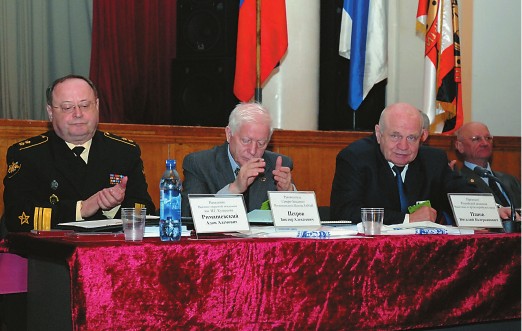
The results of the reports and lively discussions were summed up by RARAN President Vitaly Panov. He once again emphasized that in order to determine the new look of the Russian Armed Forces, it is necessary, first of all, to assess in detail the threats to its security, and then select priority areas of development, taking into account resource and economic components.
“In contrast to the situation that developed in the last decades of the last century, today’s threats to the security and national interests of Russia are gradually becoming complex,” noted V.V. Panov. – The current situation requires scientific research and the use of scientific research results to justify political, economic and military decisions. I am confident that the twelfth conference “Current problems of protection and security” will make a feasible contribution to solving these problems.
On the same day, as part of the conference, public hearings were held, at which military personnel, scientists, engineers and specialists from defense industry enterprises interestedly and sometimes very emotionally discussed with representatives of the Public Chamber of the Russian Federation the tasks facing the defense industry.