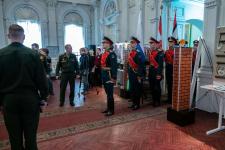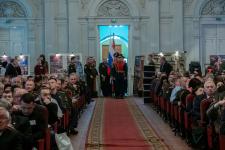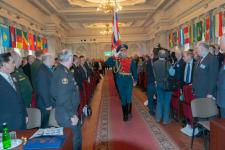
XXII APZB Conference
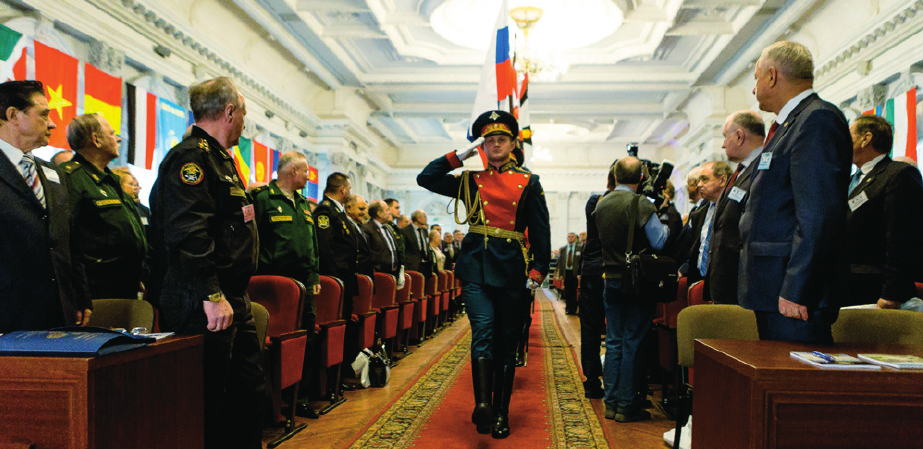
WIN NOT BY NUMBERS, BUT BY SKILL
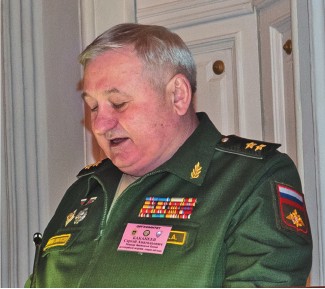
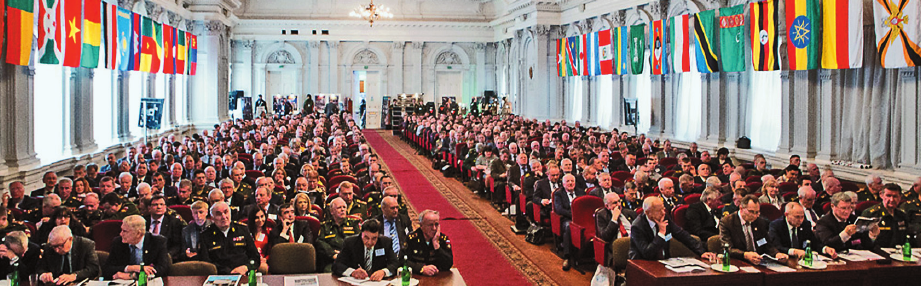
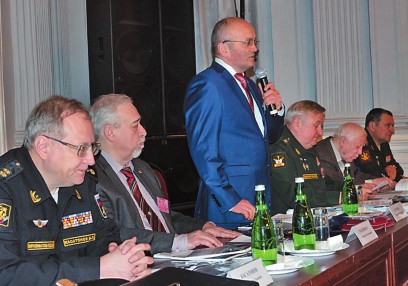
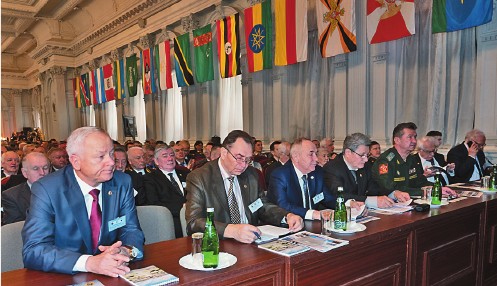
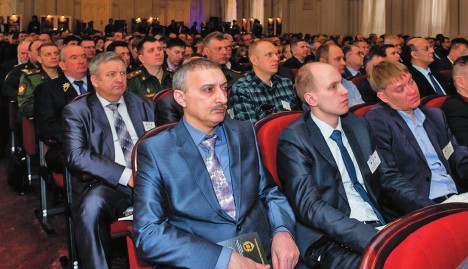
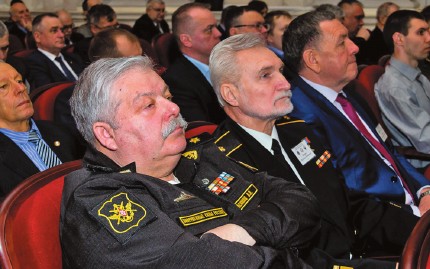
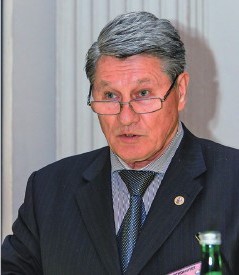
“We have gathered in order to, taking into account the emerging geopolitical situation in the world, based on a deep analysis of threats, develop specific proposals for improving the comprehensive security of the country. During the discussion on the problematic issues of the conference, there will be a comprehensive discussion of them and practical recommendations will be developed that will make it possible to most effectively realize the possibilities of strengthening the defense capability of our Motherland,” said Lieutenant General S. Bakaneev, head of the Moscow Military Academy, when opening the meeting.
Each conference, and the current one is the 22nd in a row, is a kind of indicator of the state of the state’s military organization: if in the late 90s it was important to understand what was left of the USSR Armed Forces and industry and how to revive defense potential, now most of the reports were aimed at solving specific defense problems.
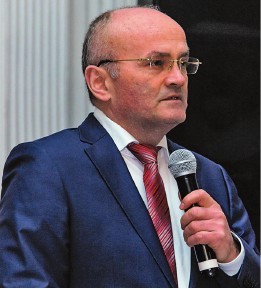
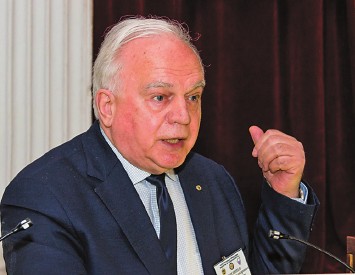
“The range of threats is very wide - ranging from space, economic, information, military, environmental. And our task is to find effective means to minimize their impact,” RARAN President V. Burenok advised the conference participants.
It is no coincidence that symposiums on thematic aspects were held on the basis of parent enterprises and institutes.
Issues of the development of weapons and military equipment, including improving the combat use of missile forces and artillery, were discussed at the MVAA, a forge of artillery personnel with a centuries-old history. Technical means of countering terrorism are at the site of NPO SM CJSC, where defensive weapons are developed and manufactured. The improvement of armored vehicles was discussed at the Trans-Mash Research Institute. The problems of the Navy were analyzed under the guidance of specialists from the All-Russian Scientific Center of the Navy “Naval Academy named after Admiral of the Soviet Union N.G. Kuznetsova". Ensuring comprehensive security in transport was considered on the basis of the St. Petersburg State University of Civil Aviation. Security problems of special-purpose infocommunication systems - at the Military Academy of Communications named after S.M. Budyonny. Issues of logistical support for troops andforces in modern operations - on the site of the Military Engineering and Technical Institute of the Military Academy of MTO named after Army General A.V. Khruleva.
Perhaps the main visual aid of the plenary session of the conference was the map of the world, which outlined the forces directed against Russia in Europe, in the Atlantic, Pacific, Mediterranean and Arctic theaters of operations. If we compare the current threat schemes with those published during the Soviet era, we will see an increased concentration of NATO forces. True, our country’s territory was much larger then. Accordingly, the time it took for missiles and aircraft to approach our strategic targets was longer. If then we were threatened from ground bases, surface, underwater and air carriers, now the real danger also comes from space.
As Academician of the Russian Academy of Sciences M. Marov noted, we are talking not only about the vagaries of “space weather”, hard electromagnetic radiation and corpuscular radiation affecting solar-terrestrial connections, and not about super-powerful solar flares, one of which in the late 1990s practically paralyzed the province of Quebec in Canada. There are impacts that solar radiation has on spacecraft instruments and ground systems, causing breakdowns in insulators, blocking chips, other elements and devices. Various types of influence on the Earth's ionosphere lead to very strong changes in the accuracy of navigation systems. The asteroid-comet hazard remains very significant, causing explosions equivalent to megatons of TNT. A similar cataclysm occurred in 2013 with the fall of the Chelyabinsk meteorite, which led to very serious consequences. Space constellations are vulnerable, examples are knowndestruction of satellites in orbit. On the agenda is the lunar program - a very significant stage in the development of civilization, but certain circles in the West are not averse to using the Earth’s largest satellite for military purposes.
An even more tangible and by no means sci-fi threat comes from American missiles, the most effective of which are considered tomahawks. There are more than four thousand of them in NATO arsenals.
Deputy General Designer - Head of the JSC KBSM Department of the Almaz-Antey Concern A. Vorobyov dedicated his report “Solving National Security Problems in the Conditions of the American Concept of Instant Strike with Strategic ICBMs and Precision Weapons” to this problem: “The new US military strategy is an instant strike with cruise missiles on vital Russian targets. First of all, for ICBM position areas, control centers, power units, megacities and other targets. A systematic approach requires building protection for Russia’s strategic facilities from all types of weapons. That is, not only from cruise missiles, but also from land- and sea-based ICBMs. We see a system of such protection in the form of a multi-echelon structure. The developed mathematical model allows us to determine the probability of survival of our missiles and estimate how many defense systems are neededbuild to ensure a retaliatory strike capable of causing unacceptable damage to a potential enemy.”
The head of the MVAA, Lieutenant General S. Bakaneev, noted that “the processes taking place today in world politics, primarily related to the termination of the Intermediate-Range Nuclear Forces Treaty, the threat of deploying missile systems with a range of up to 5 thousand kilometers in Europe and in countries directly bordering Russia, most directly affect missile forces and artillery. Current trends in the development of missiles and artillery weapons in NATO countries indicate that the role of this component of armed struggle has recently become increasingly important. Very indicative in this regard is the information that has emerged about the plans of the US Army to significantly modernize field artillery, including barrel artillery, multiple launch rocket systems (MLRS) and missile weapons. Moreover, this is expected to be done in a very short time.It is obvious that the emergence of new military threats requires a prompt and effective response from our branch of the military and from the country’s military-industrial complex. In connection with the latest tectonic shifts in the field of military policy of Western countries, we can confidently predict the special importance of the Iskander-M missile system in the overall structure of the Russian Armed Forces.
Together with JSC NPO SPLAV, work is being carried out to improve promising 300 mm and 120 mm MLRS with increased range. We also participate in research on the development of a wide range of guided missiles. In the field of cannon artillery, development of the promising self-propelled artillery complex “Coalition-SV” is underway.
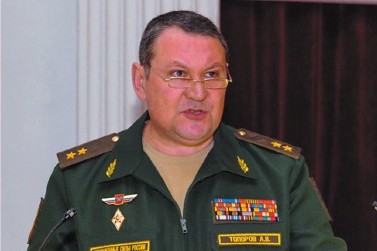
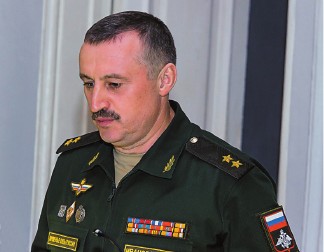
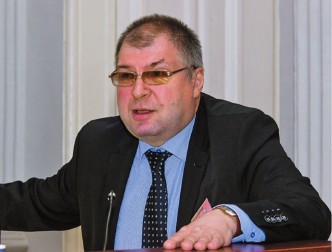
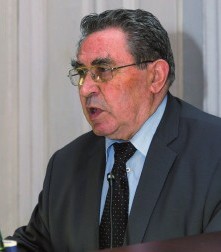
Interaction with leading enterprises and organizations of the military-industrial complex and the development of all areas of research activity will continue to strengthen and deepen.”
A special section of threats is associated with the hybrid war, which has already de facto been unleashed against Russia.
“If relatively recently we perceived such concepts as cyber threat and cyber attack as hooliganism or a game, then recently this has become an increasingly pressing problem,” noted Corresponding Member of RARAN V. Shved. Leading NATO countries have created special cyber units that are dedicated to their work in a substantive and professional manner. I think everyone is hearing about the disruptions in the energy sector in Venezuela. Perhaps the problems in the domestic banking system are less well known, but they really existed and continue, and the introduction of the MIR card is not a spontaneous decision. The danger of computer attacks was identified long ago by the Department of Defense. And to counteract them, systems were developed to identify them and prevent computer attacks. But since there is a human factor involved, it is difficult to completely algorithmize this process. Therefore, it is proposed to introduce a heuristicblock in which risk assessment criteria will be formulated to further counter them. The Ministry of Defense is aware of the situation, and work will be presented in the near future, which, I hope, will mark the beginning of a solution to this problem.”
Computer modeling systems and high-speed programs are becoming commonplace when making decisions in our Armed Forces: from strategic planning to the actions of a specific unit or even an individual combat unit.
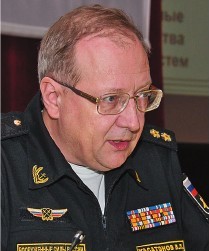
The head of the VUNTS Naval Academy, Vice Admiral V. Kasatonov, substantiated the effectiveness of the use of interspecific groupings in comparison with other military structures:
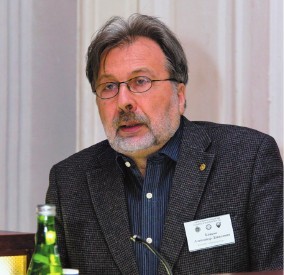
“Interspecific groupings in theaters of military operations are the largest object of construction; their total composition is almost equal to the composition of the Armed Forces. Each group must become balanced, including an acceptable balance between the strike, support, service and control subsystems. The properties of the group characterize the ability to withstand the combat potential of the enemy and inflict certain damage on him while ensuring one’s own security.”
Vice Admiral Kasatonov proposed “an adequate criterion, a means for measuring the spatial and temporal properties of a group, its operational mobility,” allowing “to link the spatial and temporal properties of the group with the total combat potential, to measure the degree of feasibility of the group’s combat potential, the degree and level of the group’s readiness to concentrate efforts in the chosen direction.”
According to the speaker, such a universal criterion for the combat readiness of a group from the point of view of the principles of military art should be a new criterion - the impulse of combat potential.
“The product of the combat potential of an element of the organizational structure and its operational speed reflects the contribution of each element to the operational mobility of the group. Such a product is called the impulse of combat potential by analogy with a physical quantity - the product of a body’s mass and its speed. The impulse of combat potential is a numerical expression of the ability of an element of the organizational structure to concentrate efforts in a chosen direction. Comparing the impulses of the combat potential of two groups - one's own and the enemy's - allows one to make a judgment about the operational capabilities of the groups, which is the most important component of military forecasting. Analysis of the impulses of the combat potentials of groups allows, instead of the traditional answer “the strongest will win,” to receive an answer, according to Suvorov, that is more consistent with the principles of military art: “It is not the strongest who will win, but the eye, speed and onslaught that will win.”Thus, the use of a systematic approach to the analysis of the operational capabilities of a unified combat system of an interspecific group makes it possible to build formations with specified properties.”
In turn, Academician of RARAN Yu. Podoplekin calculated the principles of forming a single information space in a tactical group of ships using various types of communications and developing target designation for missile weapons. It is based on a multi-circuit system: from collecting data on the enemy’s state, processing the information received, to determining the number of missiles in a salvo and transmitting target designation on board each missile to effectively complete the task.
A unified information space in the World Ocean is especially important when using unmanned vehicles - aircraft, surface and underwater.
Currently, the Poseidon complexes—high-speed, deep-sea, “smart” super-torpedoes with nuclear power plants—are being successfully tested2. Meanwhile, the head of the sector of the Oceanpribor concern, A. Konson, introduced the conference participants to the development of integrated search and survey systems for underwater robotic complexes: “Ideas are being developed to create a multi-agent robot system, a so-called swarm, which has collective intelligence.” That is, a group of underwater drones will be able to work according to a single task, while each “underwater mechanical soldier” will know his maneuver.
The developers take into account that “there are certain limitations in the underwater environment. The range of acoustic communications is quite limited, this is due to the properties of the medium due to the refraction and bending of rays that occur in a heterogeneous environment (the range with weak radiation can reach about 5–10 kilometers). In addition, the speed of signal propagation in water is 200 thousand times slower than in air. As a result, the volume of information transmitted under water can be on the order of several hundred bytes per second.” However, scientists, in the interests of national defense, are finding ways to overcome these natural difficulties.
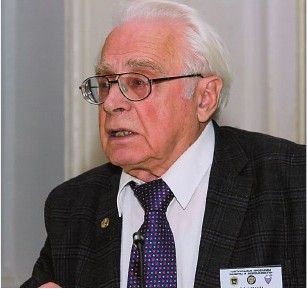
Rector of the Baltic State Technical University K. Ivanov shared the development of Voenmech, nominated for the State Prize of the Russian Federation.
“The Aerospace Forces warehouses contain a large number of FOTAB illumination aerial bombs with expired warranty storage period. The military was asked to develop a simple and cost-effective technology for disposing of these bombs. We came to the conclusion that disposal is quite expensive, and after appropriate modifications we proposed using the former flare bombs as high-explosive bombs, replacing the fuse. Tests have shown the effectiveness of our solutions. Our work was awarded the Zhukov Prize “for the development of new types of disposal of aircraft bombs and changing their status.”
And one more advanced development. Scientific director of JSC VNIItransmash, corresponding member of RARAN V. Stepanov introduced the conference participants to the prospects of using a powerful source of electrical energy on board military tracked vehicles in the form of a hybrid power plant based on an internal combustion engine. In addition to purely operational advantages, this makes it possible to use promising types of weapons and protection based on non-traditional operating principles (laser, microwave weapons, electrothermochemical and rail guns, electrodynamic protection, electronic warfare, etc.)
The head of the Military Academy of Logistics and Technical Support named after Army General A.V. introduced the conference participants to the new equipment supplied to the Armed Forces on behalf of the Deputy Minister of Defense of the Russian Federation, General of the Army D. Bulgakov. Khrulev, Lieutenant General A. Toporov and the head of the Military Engineering and Technical Institute of the Military Academy of MTO, Colonel V. Konovalov.
Currently, a multifunctional modular complex for the life support of the aviation commandant's office, a group refueling kit for aircraft, a liquid crystal projector for aviation indicators, and a robotic front-line platform for performing logistics support tasks are being prepared for state testing. For example, a robotic front-line logistics platform based on a multi-purpose tracked chassis is capable of evacuating damaged weapons and equipment, delivering fuel and ammunition to the area, and evacuating the wounded and sick.
Over the past two years alone, more than ten promising samples of logistics equipment have been accepted for supply with the military-scientific support of RARAN scientists. This year we expect to accept five more for supply.
Samples of weapons, military and special equipment are presented at the exhibition on the sidelines of the conference.
The range of reports, scientific reports and presentations covered the entire range of problems of ensuring the country's security: from the organization of service in the army, navy, the activities of the military police, law enforcement agencies and intelligence services to suppress illegal actions, illegal weapons trafficking, crimes in the financial and economic sphere and to solving problems of environmental safety, health protection, and improving the demographic situation.
The conference participants were informed about events related to the centenary of Mikhail Timofeevich Kalashnikov. The creators of modern military and special equipment, military leaders paid tribute to the memory of RARAN academicians Yuri Tomashov and Nikolai Makovets, who left us on the eve of the conference.
Under the leadership of Hero of Socialist Labor Yuri Vasilyevich Tomashov, a line of mobile artillery installations was created at the Transmash Central Design Bureau. Thanks to the efforts of Hero of Russia Nikolai Aleksandrovich Makarovets, NPO Splav has developed high-precision projectiles for multiple launch rocket systems.
President of RARAN V. Burenok emphasized the need to strengthen scientific schools and the continuity of generations of researchers, designers and production workers.
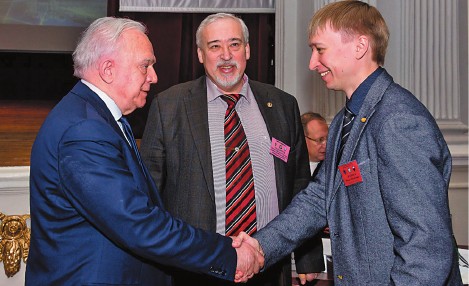
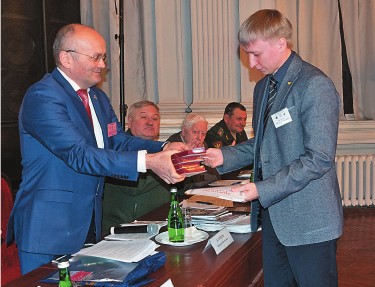
V. Burenok summed up the results of the competition for young scientists held by RARAN. In three nominations related to scientific research and development of new technology, instruments and materials, the work of 32 promising employees of the country's leading research and production teams was recognized. On behalf of the President of RARAN, diplomas will be presented to the competition laureates by the Chairman of the Council of Young Scientists, Director of the Special Materials Plant of NPO SM CJSC N. Silnikov.